In the introduction, user 1024 asked for something for a late-night drive in the rain, with no vocals and nothing too old. Whether track #0381 is an answer depends on what the database knows about it. The catalog supplied two columns for free, genre (jazz) and year (2019), but the columns the request actually turns on, mood and instruments, are empty. Annotation is the task of filling them, and of adding the columns no one has filled yet. This page is about which capabilities of LLMs change how that is done.
How LLMs help annotation
Three capabilities of LLMs, each introduced in Chapter 1, change what annotation can do (Figure 1).
Multimodal understanding: the model hears the track and knows the world. An audio encoder and a small adapter map music into the LLM’s token space, so the model reads a track the way it reads a sentence. The model that hears a brushed snare also knows what a piano trio is, what nocturnal tends to mean in jazz, and that 2019 is recent. A tagger heard the audio and knew nothing else. An LLM brings the vocabulary and world knowledge of text to every track it listens to.
Autoregressive generation: the output is open. The model writes one token at a time, so a label, a database field, and a full sentence come out of the same mechanism. A column is no longer limited to the values a model was trained on: instruments can hold piano trio, and a caption can say how the instruments relate. Known fields can be given as the start of the sequence and the missing ones written after them, which turns filling in a row into continuing a text.
Multitask instruction following: one model fills many columns. The task is named in the instruction rather than fixed at training time. “Add mood and instruments, then write a caption” asks for three columns at once, and a new column costs a new instruction rather than a new dataset and a new model.
Together, the three let one model fill many columns of the database, from one set of weights, in whatever form each column needs. The next two sections take multitask and autoregressive generation in turn; the last two cover how the result is evaluated and where it still falls short.
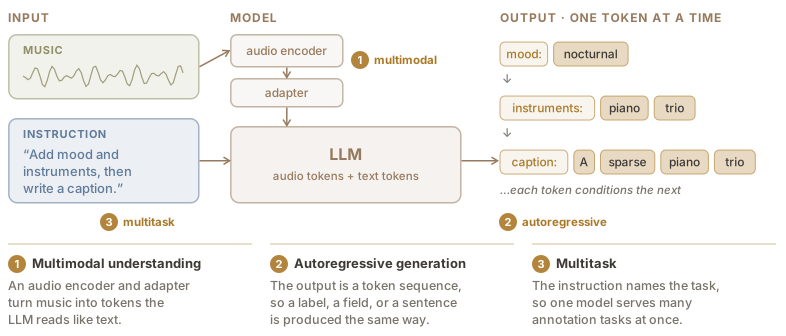
Figure 1:Three LLM capabilities behind music annotation. (1) An audio encoder and adapter turn music into tokens the LLM can read. (2) The output is generated one token at a time, so a label, a field, and a sentence come out the same way. (3) The instruction names the task, so one model serves many tasks.
One model, many tasks
Before LLMs, each column had its own model. A genre classifier filled genre, an instrument classifier filled instruments, and a captioner wrote the caption, each trained on its own labeled dataset and each limited to what that dataset contained: a tagger’s vocabulary was typically around fifty labels, and captioned audio existed only in the thousands 1234. Adding a column meant collecting a dataset and training a model. Our earlier tutorial covers this generation of tagging and captioning models in depth 5.
Audio-language LLMs replace the row of models with one (Figure 2). The models in this family share a design: a pretrained music audio encoder feeds a pretrained LLM through a small adapter, and the pair is tuned on instruction data that was itself written by an LLM from existing annotations. MU-LLaMA uses MERT features and builds its question-answer data from caption datasets 6. LLark converts the annotations of several open datasets (tags, keys, tempi, captions) into one instruction format 7. MusiLingo and SALMONN follow the same recipe, the latter for speech, sound, and music in one model 89. Music Flamingo scales it, with long captions and question-answer pairs about harmony, structure, timbre, lyrics, and cultural context, followed by chain-of-thought and reinforcement-learning stages 10. Chapter 2 covers the architectures. What matters here is that the many datasets of the previous generation become many instructions for one model.
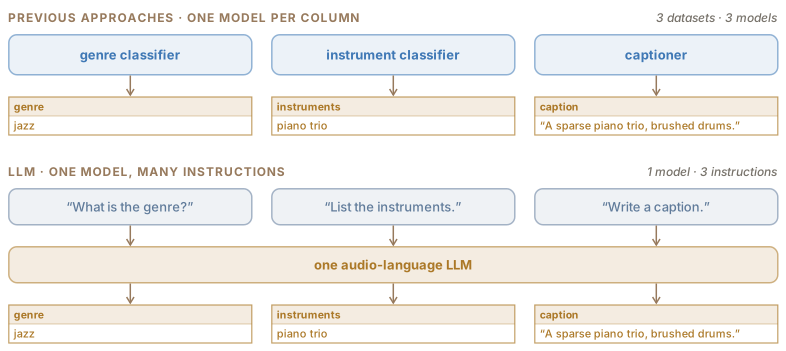
Figure 2:One model per column versus one model for many columns. Previous approaches train a separate model for each column of the database; an audio-language LLM fills the same columns from one set of weights, with the instruction choosing the column.
For the database, the consequence is that a column is defined at inference time. A new column, fits a night drive or what the lyrics are about, costs one instruction rather than one model. A zero-shot instruction defines the column in words (“rate the energy from 1 to 5”). A few-shot instruction defines it by example: a handful of tracks annotated the way an editor would, placed in the context, and the model continues the pattern across the catalog in the editor’s vocabulary 11. CMI-Bench shows the scale of the change: one checkpoint answers thirteen standard MIR tasks posed as instructions, where the supervised baselines are thirteen separate models 12. At catalog scale, one model that is somewhat worse on each column can be more useful than thirteen models that are better on one, because the database is never finished.
Why sequence modeling fits annotation
Autoregressive generation is what opens the output. A caption is a sequence: the model predicts each word from the audio, the instruction, and the words already written (Figure 3). Nothing restricts the next word to a fixed vocabulary, so the caption for #0381 can say piano trio and brushed drums, values no fifty-label tagger had. It can also state relations a label cannot: which instrument carries the melody, what changes after the intro, that the tempo is slow for a trio.
Metadata imputation is the same computation on a different sequence. Write the database row out as text, genre: jazz, year: 2019, mood: …, instruments: …, and the known fields become the context while the missing ones become the continuation. The model writes nocturnal for mood and piano trio for instruments, each conditioned on the audio and on everything before it, including the fields the catalog already had. Music metadata LLMs make this a central task: audio and a partial set of fields in, the missing fields out, so a catalog with a genre but no mood is completed rather than rewritten 13.
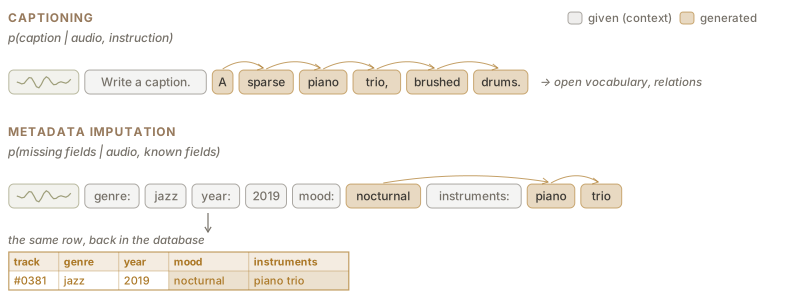
Figure 3:Captioning and metadata imputation as sequence modeling. Gray tokens are given as context; amber tokens are generated, each conditioned on everything before it.
The two tasks differ in what the model is given besides the audio and the instruction, and that decides when each is the right tool.
| Audio → information | Audio + metadata → information | |
|---|---|---|
| Input | audio, instruction | audio, instruction, the row so far |
| Typical tasks | captioning, tagging, question answering | metadata imputation, conditioned captioning, consistency checking |
| Right tool for | a new release with only audio; a column no one has filled | a catalog with partial, noisy, or inconsistent fields |
| What goes wrong | invents what the audio cannot carry (year, artist) | inherits errors already in the row |
Generating from the row also keeps the row consistent. Because every token is conditioned on the fields before it, a caption written after year: 2019 will not describe a 1950s recording, and a field the audio contradicts, such as vocals: yes on an instrumental, can be flagged instead of propagated. The output can be as structured as the database needs, a JSON object or a table row, since a structure is only a sequence with a format. The weakness is the mirror image: whatever is wrong in the row goes in as context and tends to come out confirmed.
Evaluation
Annotation is evaluated differently from understanding. Chapter 2 asks what a model knows and can reason about, usually through question answering. Annotation produces a column in the database, so it is judged the way MIR models always were: on each task’s datasets, with each task’s metrics. What changes is the ability under test. The question is no longer whether a model built for genre classifies genre, but whether one model, told in words which column to fill, fills it correctly and in the form the column needs. The ability being measured is instruction following.
CMI-Bench is built around exactly this 12. It recasts thirteen standard MIR tasks, from tagging and key detection to melody extraction and lyrics transcription, as instructions, and scores eleven audio-text LLMs with each task’s usual metric. The numbers can therefore be compared directly with supervised models, and because each answer has to be scored by that metric, it has to come back in the form the task expects: a label from the set, a key name, beat times. Figure 4 shows six of the tasks. The pattern follows the capabilities above: parity on captioning, the one task whose output is open; ten to twenty points behind on categories such as tags, genre, and instruments; and far behind on measurements such as key and beat. The comparison is one-sided, though. Each supervised score comes from the best model built and tuned for that row, while the LLM is one checkpoint answering every row from an instruction. That it lands within reach on categories, and at parity on captioning, is the result worth noticing. As with understanding benchmarks, it also has to be checked that the answers came from the audio rather than from the wording of the instruction 1415.
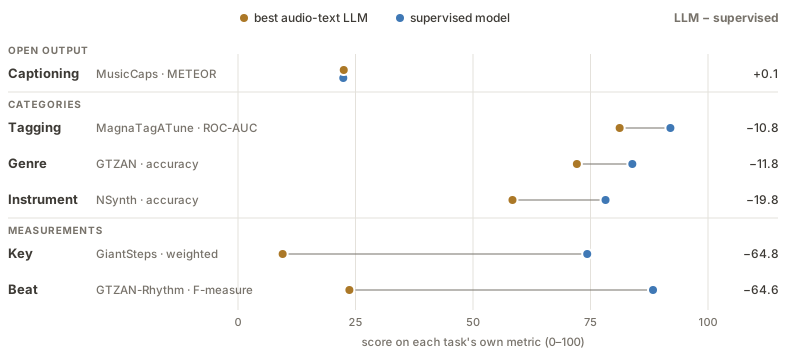
Figure 4:The best audio-text LLM against the best supervised model on six CMI-Bench tasks 12. Each task is scored on its own metric, so compare the gap within a row, not positions across rows.
Captioning is where the MIR recipe runs out. There is no label to match, and many different sentences describe #0381 correctly. Three approaches are in use.
Reference-based. The caption is compared with one or more human-written references. N-gram metrics borrowed from machine translation and image captioning, such as BLEU, METEOR, and CIDEr, are cheap and reproducible, but they reward word overlap with a particular sentence, and they correlate poorly with whether the description fits the music 16. A correct caption phrased differently from the reference scores low, and when the reference was itself written by an LLM, our reading is that the metrics also reward its house style.
Reference-free. The caption is scored against the audio directly, as the similarity between the two in a joint audio-text embedding such as CLAP 17. No reference is needed, so any track in the catalog can be scored. Embedding similarity is coarse, however: it misses errors of syntax and small hallucinations.
LLM-as-a-judge. An LLM reads the caption, scores it against a rubric, and explains the score. In general text generation, strong LLM judges agree with human preferences about as well as humans agree with each other 18. Multimodal LLMs extend the judge beyond text: given the non-text input as well as the response, they compare two answers reliably, though their absolute scores and rankings drift further from human ones 19. Music models have begun to use judges in both roles, to evaluate and to curate. Music Flamingo reports the correctness and coverage of its long-form captions with an LLM judge, keeps only training captions and question–answer pairs that a multimodal LLM verifies, and checks its reasoning chains step by step against the audio 10. LLM2Fx-Tools uses an LLM judge to score instruction following and the quality of the model’s reasoning, outputs that have no single reference, and to flag weak training samples for regeneration 20. AudioCapBench scores accuracy, completeness, and hallucination separately, and finds music the hardest of its three domains 21. We think this is the most promising direction for annotation in particular. A caption makes claims, a piano trio, brushed drums, no vocals, and a judge with access to the audio and the row can check them one at a time, so the score says what is wrong and not only how much. Judges have their own biases, toward their own phrasing and toward the wording of the prompt, so a judge should be calibrated against a small set of human ratings before it scores a catalog.
Limitations and future challenges
Time-aligned measurements. On tasks whose answer is a sequence of events placed on the waveform, LLMs are not yet usable: in CMI-Bench the best model reaches 23.7 on beat tracking against 88.3 for a supervised tracker, and 9.5 against 74.3 on key detection 12. Chord recognition and structure analysis are not in the instruction benchmarks at all. The reason is structural rather than a matter of scale: the model emits one token at a time from a pooled audio representation, while beats, chords, and section boundaries are dense outputs at frame resolution. Challenge: let the LLM call supervised MIR models as tools, the agent pattern of Chapter 1, or give it audio representations that keep time.
One row per track. Without reliable structure analysis there is no segment to attach a description to. A quiet intro and a busier second half share one row, and nocturnal may be true of half the track. Challenge: rows per section, so that search can point to the part of a track that fits.
World knowledge cuts both ways. The knowledge that fills columns the audio cannot carry is also where the model is most confidently wrong. A model that invents a release year for one obscure track does so for a million, and the error is then indexed and searched; LLM recommenders have been shown to name items that do not exist 22. Challenge: record where each cell came from (audio, catalog, or model knowledge) and ground the knowledge-based columns in sources.
Errors in the row are confirmed. Imputation conditions on the fields it is given, so a wrong genre goes in as context and comes out supported by a matching mood. Challenge: check each given field against the audio before writing new ones.
Evaluating the database, not the answer. Every benchmark above scores one answer to one question. What a listening system needs is a database that is complete, consistent across columns, and useful downstream, and no benchmark measures that yet. Challenge: score annotation by what it does for search/retrieval and recommendation, the subject of the next pages.
- Turnbull, D., Barrington, L., Torres, D., & Lanckriet, G. (2008). Semantic annotation and retrieval of music and sound effects. IEEE Transactions on Audio, Speech, and Language Processing, 16(2), 467–476.
- Nam, J., Choi, K., Lee, J., Chou, S.-Y., & Yang, Y.-H. (2018). Deep learning for audio-based music classification and tagging: Teaching computers to distinguish rock from bach. IEEE Signal Processing Magazine.
- Manco, I., Benetos, E., Quinton, E., & Fazekas, G. (2021). Muscaps: Generating captions for music audio. 2021 International Joint Conference on Neural Networks (IJCNN), 1–8.
- Manco, I., Weck, B., Doh, S., Won, M., Zhang, Y., Bogdanov, D., Wu, Y., Chen, K., Tovstogan, P., Benetos, E., & others. (2023). The Song Describer Dataset: A corpus of audio captions for music-and-language evaluation. arXiv Preprint arXiv:2311.10057.
- Doh, S., Manco, I., Novack, Z., Kim, J. W., & Chen, K. (2024). Connecting Music Audio and Natural Language. Tutorial at the International Society for Music Information Retrieval Conference (ISMIR). https://mulab-mir.github.io/music-language-tutorial/
- Liu, S., Hussain, A. S., Sun, C., & Shan, Y. (2024). Music Understanding LLaMA: Advancing Text-to-Music Generation with Question Answering and Captioning. ICASSP 2024 - 2024 IEEE International Conference on Acoustics, Speech and Signal Processing (ICASSP), 286–290. 10.1109/ICASSP48485.2024.10447027
- Gardner, J. P., Durand, S., Stoller, D., & Bittner, R. M. (2024). LLark: A Multimodal Instruction-Following Language Model for Music. Proceedings of the 41st International Conference on Machine Learning, 235, 15037–15082. https://proceedings.mlr.press/v235/gardner24a.html
- Deng, Z., Ma, Y., Liu, Y., Guo, R., Zhang, G., Chen, W., Huang, W., & Benetos, E. (2024). MusiLingo: Bridging Music and Text with Pre-trained Language Models for Music Captioning and Query Response. In K. Duh, H. Gomez, & S. Bethard (Eds.), Findings of the Association for Computational Linguistics: NAACL 2024 (pp. 3643–3655). Association for Computational Linguistics. https://aclanthology.org/2024.findings-naacl.231
- Tang, C., Yu, W., Sun, G., Chen, X., Tan, T., Li, W., Lu, L., Ma, Z., & Zhang, C. (2024). SALMONN: Towards Generic Hearing Abilities for Large Language Models. The Twelfth International Conference on Learning Representations. https://openreview.net/forum?id=14rn7HpKVk
- Ghosh, S., Goel, A., Koroshinadze, L., Lee, S., Kong, Z., Santos, J. F., Duraiswami, R., Manocha, D., Ping, W., Shoeybi, M., & others. (2026). Music Flamingo: Scaling Music Understanding in Audio Language Models. International Conference on Learning Representations (ICLR). https://arxiv.org/abs/2511.10289
- Kong, Z., Goel, A., Badlani, R., Ping, W., Valle, R., & Catanzaro, B. (2024). Audio Flamingo: A Novel Audio Language Model with Few-Shot Learning and Dialogue Abilities. ICML. https://openreview.net/forum?id=WYi3WKZjYe
- Ma, Y., Li, S., Yu, J., Benetos, E., & Maezawa, A. (2025). CMI-Bench: A Comprehensive Benchmark for Evaluating Music Instruction Following. Proceedings of the 26th International Society for Music Information Retrieval Conference (ISMIR). 10.5281/zenodo.17706469
- Bukey, I., Wang, Z., Donahue, C., & Bryan, N. J. (2026). Rethinking Music Captioning with Music Metadata LLMs. ICASSP 2026 – 2026 IEEE International Conference on Acoustics, Speech and Signal Processing (ICASSP). https://arxiv.org/abs/2602.03023
- Weck, B., Manco, I., Benetos, E., Quinton, E., Fazekas, G., & Bogdanov, D. (2024, August). MuChoMusic: Evaluating Music Understanding in Multimodal Audio-Language Models. 25th International Society for Music Information Retrieval Conference. 10.48550/arXiv.2408.01337
- Zang, Y., O’Brien, S., Berg-Kirkpatrick, T., McAuley, J., & Novack, Z. (2025). Are You Really Listening? Boosting Perceptual Awareness in Music-QA Benchmarks. arXiv Preprint arXiv:2504.00369.