Perceiving the score for performance
A score encodes far more than pitch and rhythm. In this section, we introduce preliminarily the elements that drive performance decisions: dynamics, timing, touch, gesture, and examine how much they get covered in current LLM-based systems.
What the score carries for performance
Dynamics: absolute levels (pp, ff) and relative changes (cresc., dim., sfz). Their interpretation is context-dependent: the same forte behaves differently across register, instrument, and texture Kosta et al. (2018), Kim et al. (2025).
Articulation governs inter-note connectivity: legato, staccato, accent, tenuto, marcato Bresin & Battel (2000).
Tempo markings range from verbal designations (Allegro, Adagio) to qualified phrases (Allegro ma non troppo) to metronome numbers.
Phrasing: slurs, phrase marks, breath marks, specifies grouping and connection. A slur implies a single bow stroke for a cellist, a single breath for an oboist, a bound syllable for a singer; the physical realisation is instrument-specific. Phrase contours also define where expressive shaping (dynamic swell, agogic delay) is applied.
Ornamental gestures: trills, turns, mordents, appoggiaturas, shorthand for note sequences whose rhythmic realisation depends on period, instrument, and tempo.
Pedal indications (sustain, sostenuto, una corda) are primarily for keyboard instruments and interact with harmonic rhythm and decay.
Execution-level markings such as fingering (piano, guitar), bowing direction, string/position choice (sul G, IV. Saite), contact-point (sul ponticello, sul tasto), and breath marks and tonguing.
Text expression marks (dolce, con fuoco, misterioso, senza sordino) are natural-language performance instructions requiring semantic understanding.
Non-classical directives: jazz and popular lead sheets carry chord symbols that leave voicing unspecified, swing feel implicit in style markings (bossa nova, shuffle), and groove/feel annotation that determines rhythmic interpretation.
Mid-level derived properties
Performers and automated systems synthesise the above into higher-order estimates:
Difficulty aggregates fingering complexity, hand-position shifts, tempo, and dynamic range into a learner-facing estimate Ramoneda et al. (2023), Ramoneda et al. (2024).
Technique understanding (hand-crossing, thumb-under passage) are not directly notated but inferable from score context and instrument knowledge.
Symbolic Input of Score
Multiple text-based encodings serve as LLM input for symbolic score understanding. ABC notation is the most common. The standard supports dynamics, articulation, slurs, ornaments, and bowing direction as decorations, but fewer than one tune in a hundred on abcnotation.com uses any decoration Walshaw (2011). IrishMAN Wu et al. (2023), the folk-tune corpus most ABC models train on, is drawn from the same site and thesession.org, so models learn pitch and rhythm only. ChatMusician Yuan et al. (2024) treats ABC as a second language and reaches structural competence in harmony, melodic generation, and music-theory QA; performance interpretation is outside scope. ABC-Eval Zhao et al. (2025) benchmarks seven LLMs on ten ABC-based sub-tasks and confirms systematic weakness in performance-marking comprehension.
MIDI encodes pitch, onset, duration, and velocity: it captures expressive timing and dynamics implicitly but carries no slurs, articulation text, fingering, or bowing. MIDI-LLaMA Yang et al. (2026) fine-tunes a multimodal LLM on MIDI tokens for captioning, emotion recognition, and QA. Adversarial masked pre-training on MIDI Zhao (2024) improves contextual understanding on music information retrieval tasks. Both remain bounded by MIDI’s structural limits.
LilyPond and Humdrum **kern Ríos-Vila et al. (2024) offer more compact text representations; **kern is the most token-efficient among common formats. LilyBench Spanio et al. (2026) evaluates four code-specialised LLMs on LilyPond generation and ten understanding sub-tasks. Models perform well on metadata retrieval, music captioning, and genre recognition, but near zero on bar-counting and error detection. Performance directives (dynamics, articulation, fingering) are not addressed in the benchmark, confirming the same coverage gap as ABC and MIDI.
MusicXML is the richest carrier of performance directives, with dedicated elements for fingering, bowing, dynamics, articulation, ornaments, and text expressions. No published work uses it as direct LLM input: its XML boilerplate expands a single measure into hundreds of tokens, making full-piece input infeasible within standard context windows Ríos-Vila et al. (2024). The format most complete in performance information is, for now, the least accessible to language models.
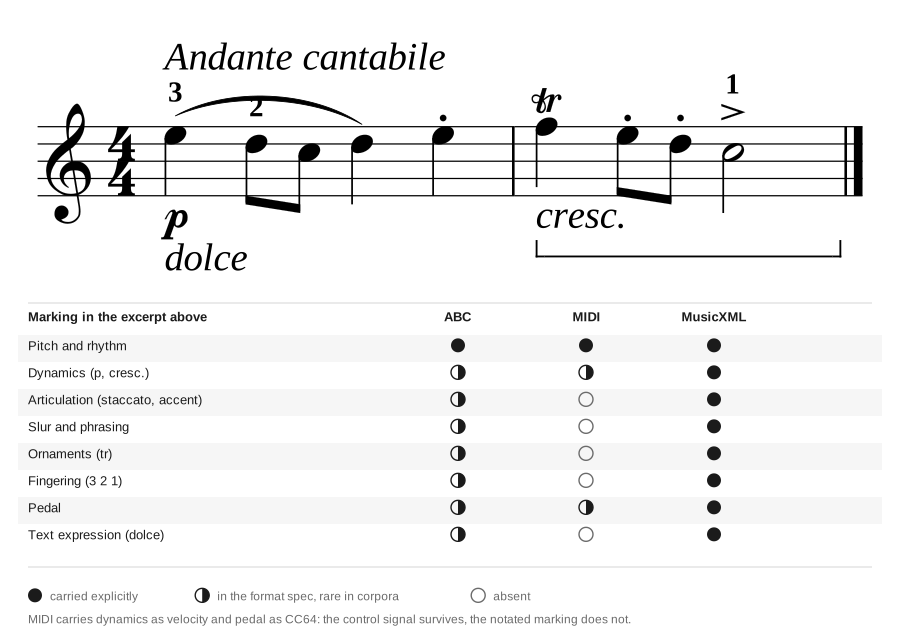
Figure 1:Every marking in these two bars drives a performance decision. Only the top row survives into all three encodings. ABC can express most of the rest, but its training corpora rarely populate those fields Yuan et al. (2024), Zhao et al. (2025); MIDI drops the notation and keeps only what is measurable in the signal; MusicXML carries everything and is the one format no published system feeds to a language model Ríos-Vila et al. (2024).
Sheet Music Images
Score images add a perceptual challenge on top of the symbolic one: sheet music is visually dense and hierarchically structured, with staves containing measures, measures containing beats, and beats containing notes together with articulation, dynamic, and expression marks that symbolic encodings flatten or discard.
Two directions address the visual backbone problem. MuSViT Penarrubia et al. (2026) pre-trains a vision transformer specifically on score images at scale, providing a foundation for downstream recognition tasks. SIM Qin et al. (2024) pairs score images with MIDI through masked bar-attribute modeling and score-MIDI matching, teaching the model to link what a performer sees on the page with the acoustic events it produces, a correspondence central to score-informed performance analysis.
For score understanding with language models, two granularities have been explored. NotaGPT Tang et al. (2025) operates at the note level, treating each staff element as a vision-language recognition unit and consuming both score images and ABC notation. MuseAgent Zhao et al. (2026) takes a measure-wise approach: each measure is segmented, converted to ABC notation via OMR, and passed to the language model, preserving key signature, time signature, and slur extent at the cost of fine-grained note detail.
Two benchmarks quantify the gap. MSU-Bench Dai et al. (2026) tests 15 models on 1,800 QA pairs across ABC and PDF score formats for Bach, Beethoven, Chopin, and Debussy, revealing large performance gaps across difficulty levels. SSMR-Bench Wang et al. (2025) generates sheet music reasoning problems from programmatic music-theory rules; models trained on this data transfer to existing theory and composition benchmarks.
Across all these sheet music perceiving systems, performance directives remain underrepresented. Score images contain dynamic markings, slurs, articulation symbols, and text expressions, but no current benchmark evaluates whether a model can read and reason about them in performance terms. The markings in Figure 1 are all legible on the page and all absent from the evaluation.
- Kosta, K., Bandtlow, O. F., & Chew, E. (2018). Dynamics and Relativity: Practical Implications of Dynamic Markings in the Score. Journal of New Music Research, 47(5), 438–461. 10.1080/09298215.2018.1486430
- Kim, H., Benetos, E., & Serra, X. (2025). Velocity2DMs: A Contextual Modeling Approach to Dynamics Marking Prediction in Piano Performance. IEEE Signal Processing Letters, 32, 4459–4463.
- Bresin, R., & Battel, G. U. (2000). Articulation Strategies in Expressive Piano Performance. Journal of New Music Research, 29(3), 211–226. 10.1076/jnmr.29.3.211.3092
- Ramoneda, P., Valero-Mas, J. J., Jeong, D., & Serra, X. (2023). Predicting Performance Difficulty from Piano Sheet Music Images. Proceedings of the 24th International Society for Music Information Retrieval Conference (ISMIR).
- Ramoneda, P., Jeong, D., Eremenko, V., Tamer, N. C., Miron, M., & Serra, X. (2024). Combining Piano Performance Dimensions for Score Difficulty Classification. Expert Systems with Applications, 237, 121776. 10.1016/j.eswa.2023.121776
- Walshaw, C. (2011). The abc Music Standard 2.1 [Techreport]. abcnotation.com. https://abcnotation.com/wiki/abc:standard:v2.1
- Wu, S., Li, X., Yu, F., & Sun, M. (2023). TunesFormer: Forming Irish Tunes with Control Codes by Bar Patching. Proceedings of the 2nd Workshop on Human-Centric Music Information Retrieval (HCMIR) at ISMIR.
- Yuan, R., Lin, H., Wang, Y., Tian, Z., Wu, S., Shen, T., Zhang, G., Wu, Y., Liu, C., Zhou, Z., & others. (2024). ChatMusician: Understanding and Generating Music Intrinsically with LLM. Findings of the Association for Computational Linguistics: ACL 2024, 6252–6271.
- Zhao, J., Li, Y., Li, W., & Yoshii, K. (2025). ABC-Eval: Benchmarking Large Language Models on Symbolic Music Understanding and Instruction Following. arXiv Preprint arXiv:2509.23350.
- Yang, M., McCormack, J., Llano, M. T., Su, W., & Lei, C. (2026). MIDI-LLaMA: An Instruction-Following Multimodal LLM for Symbolic Music Understanding. arXiv Preprint arXiv:2601.21740.
- Zhao, Z. (2024). Let Network Decide What to Learn: Symbolic Music Understanding Model Based on Large-scale Adversarial Pre-training. arXiv Preprint arXiv:2407.08306.
- Ríos-Vila, A., Calvo-Zaragoza, J., Rizo, D., & Paquet, T. (2024). End-to-End Full-Page Optical Music Recognition for Pianoform Sheet Music. arXiv Preprint arXiv:2405.12105.
- Spanio, M., Torabi, M., Poltronieri, A., & Rodà, A. (2026). Can LLMs Understand LilyPond? A Benchmark for Symbolic Music Generation and Understanding. Ital-IA 2026.
- Penarrubia, C., Rios-Vila, A., Fuentes-Martinez, E., Martinez-Sevilla, J. C., Castellanos, F. J., Alfaro-Contreras, M., & Calvo-Zaragoza, J. (2026). MuSViT: A Foundation Vision Model for Sheet Music Representation.
- Qin, Y., Xie, H., Ding, S., Li, Y., Tan, B., & Ye, M. (2024). Score Images as a Modality: Enhancing Symbolic Music Understanding through Large-Scale Multimodal Pre-Training. Sensors.