Chapter 1 covers how to evaluate LLMs in general: answers a program can check, LLM judges, confidence intervals, and pitfalls such as contamination. This page covers what is specific to music: which benchmarks exist, how many of their questions can be answered without the music, and what to check when you build one.
Four ways to grade
Captions. The model describes a clip, and the description is compared with a reference caption. Word-overlap metrics reward matching words, but not matching facts: in Table 1 of Chapter 1, a description with no correct facts gets the same BLEU-4 score as one with two. An LLM judge can compare meaning instead, but it must be given the facts itself.
Multiple choice. Here the model picks one of a few options. This is the dominant format, because it is gradable by construction. For example, MuChoMusic asks 1,187 four-option questions about 644 tracks from MusicCaps and the Song Describer Dataset, in a knowledge category (melody, harmony, metre and rhythm, instrumentation, and more) and a reasoning category (mood, genre, lyrics, cultural context, and more) 1. The weak point of the format is the options: if the wrong ones are implausible or leak information about the right answer, strong performance here cannot disentangle the scenario when LLMs are able to exploit this.
Labels/Classes. The model outputs a label, such as a genre, a set of instruments, or a time signature, and the label is scored against an annotation with precision, recall, and F1 2. CMI-Bench recasts 14 MIR tasks on 20 datasets as instructions in this way, so audio LLMs can be compared with specialist MIR models on the same annotations 3.
Downstream tasks. The model does some other task people need, and the result is directly on the task. MusiCRS links 477 Reddit threads asking for music recommendations, with 3,589 musical entities, to the tracks discussed, and tests models with the audio only, the query only, or both 4. It finds “optimal performance frequently occurring in single-modality settings rather than multimodal configurations”. Chapter 3 covers recommendation and search.
The benchmark landscape
Table 1 lists the benchmarks discussed in this chapter.
Table 1:Music understanding benchmarks discussed in this chapter. Sizes are as stated in each paper.
| Benchmark | Input | Format | Size | Questions from | Venue |
|---|---|---|---|---|---|
| MuChoMusic 1 | audio | multiple choice, 4 options | 1,187 questions, 644 tracks | MusicCaps and Song Describer captions | ISMIR 2024 |
| MMAU 5 | audio: speech, sound, music | multiple choice | 10,000 questions, 27 skills | human annotation | ICLR 2025 |
| MMAR 6 | audio, including mixtures | question answering | 1,000 | curated; signal, perception, semantic, and cultural layers | preprint 2025 |
| MMAU-Pro 7 | audio | question answering | 5,305 instances | — | preprint 2025 |
| CMI-Bench 3 | audio | MIR tasks as instructions | 14 tasks, 20 datasets | existing MIR annotations | ISMIR 2025 |
| RUL-MuChoMusic 8 | audio | multiple choice | MuChoMusic questions | distractors rewritten and filtered by perceptual index | ISMIR 2025 |
| MUSE 9 | audio | perception tasks | 10 tasks | — | preprint 2025 |
| BASS 10 | audio | questions on structure and semantics | 2,658 questions, 12 tasks | — | preprint 2026 |
| HumMusQA 11 | audio | multiple choice, 4 options | 320 questions, 13 dimensions | written by experts with musical training | NLP4MusA 2026 |
| Factual comprehension 2 | audio | labels, scored with F1 | 6 tasks, 3 datasets | MusicNet, FMA, OverClocked ReMix annotations | ISMIR 2026 |
| MEX 12 | audio and symbolic | tests of musical expectation models | a suite of tasks | repetition, segment boundaries, and electrophysiological responses | ISMIR 2026 |
| WildScore 13 | score image | multiple choice | 807 questions | r/musictheory, 2012–2022 | EMNLP 2025 |
| MusiXQA 14 | score image | question answering | synthetic scores | generated with MusiXTeX | preprint 2025 |
| MSU-Bench 15 | ABC text or score PDF | open questions | 1,800 questions, 150 scores | human-curated | ACL 2026 |
| MusicTheoryBench 16 | ABC text | multiple choice, 4 options | 372 questions | music knowledge and reasoning | ACL Findings 2024 |
| CSyMR 17 | **kern text | multiple choice | 126 questions | r/musictheory and college exams | SIGIR 2026 |
| SSMR-Bench 18 | text and images | question answering | 1,600 + 1,600 | generated from theory rules | preprint 2025 |
| MusICA-MetaBench 19 | audio, score images, symbolic | templated questions | any piece with MusicXML | generated from MusicXML | preprint 2026 |
| MusiCRS 4 | audio and conversation | recommendation | 477 threads | preprint 2025 |
Two trends stand out. Benchmarks are moving from questions derived from existing captions and annotations toward questions written or curated by people with musical training, and toward questions generated from symbolic data, whose answers can be computed and vertified.
What the score benchmarks show
Any VLM can be given a score image (Scores as images), and the score benchmarks in Table 1 show that reading the notation is the weak step.
MusiXQA renders synthetic scores with MusiXTeX and asks questions about their notes, text, layout, and chords 14. On optical music recognition, GPT-4o reaches 4.0 on the paper’s accuracy measure, against 68.4 for a Phi-3-Vision model fine-tuned on the dataset.
WildScore takes 807 questions about score images that people posted on the r/musictheory subreddit between 2012 and 2022 13. The best model, GPT-4.1-mini, scores 68.31% with the image and 65.76% without it. Several open VLMs score higher without the image: LLaVA goes from 32.97% with it to 37.16% without, and InternVL from 39.34% to 45.54%. A direct perception probe, with simple questions such as which clef is shown or how many symbols of a kind appear, on 50 images, finds that GPT-4.1-mini perceives the relevant symbols correctly in 52% of cases, InternVL in 38%, and LLaVA in 26%.
MSU-Bench asks 1,800 questions about 150 complete scores by Bach, Beethoven, Chopin, Debussy, and others, at four levels: onset information, notation and notes, chords and harmony, and texture and form 15. It gives LLMs the score as ABC text and VLMs the score as a PDF. The best zero-shot result with ABC is 49.44%; the best with images is 24.22%. The authors name localization, finding the right bar, as one of “two persistent challenges” for VLMs.
SSMR-Bench generates sheet-music questions from music-theory rules as programs, with 1,600 text and 1,600 visual questions 18. Because the answers are computed, they can serve as rewards: after reinforcement learning, Qwen2.5-VL-7B rises from 41.81 to 70.56 on the visual questions.
The WildScore result leads to the next question: when the image adds nothing, the model answers from the question alone.
Does the question need the music?
A benchmark for music understanding, theoretically, should contain questions that cannot be answered without the music. In the notation of the overview, a good question has
where is the correct answer (that is, conditioning on the music should make the chance of getting the answer correct higher). Many questions fail this test. A question such as “Which instrument starts the piece?” with the options acoustic guitar, synthesizer, rueful tune, and vocals can be narrowed down without hearing anything, as “rueful tune” is not an instrument at all, and a non-hearing LLM can use its general world knowledge to guess that many songs start with acoustic guitar, which would be correct!
“Are you really listening?” measured this for MuChoMusic 8. Text-only LLMs, given only the question and the options, “achieve surprisingly high accuracy of up to 56.4%, much higher than chance”. Three text-only models score above three of the five audio LLMs shown (Figure 1).
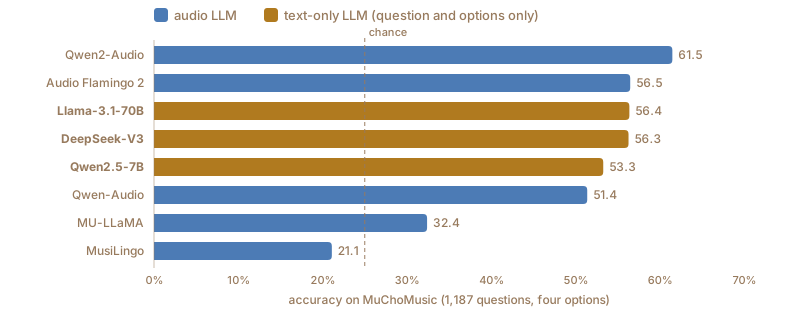
Figure 1:MuChoMusic accuracy of audio LLMs and of text-only LLMs that see only the question and options. Values are read from the figures of Zang et al. (2025).
This paper then shows how to rebuild the benchmark, particular in terms of answer options. It defines a perceptual index (PI) for a question with correct answer and distractors ,
where comes from a text-only LLM, Qwen 2.5 7B. A high PI means the text-only model prefers the wrong answers, so it needs the music to get the question right. DeepSeek-V3 writes new candidate distractors, and the PI decides which to keep. On the resulting benchmark, RUL-MuChoMusic, “text-only LMs perform at near-chance levels”. The paper also replaces the audio with noise: the audio LLMs fall, and “Qwen2-Audio showed the most dramatic performance degradation”, but they stay above chance (Figure 2).
The PI needs only a text LLM’s probabilities for each option. One way to compute it, taking as the total probability of the distractors:
import torch
from transformers import AutoModelForCausalLM, AutoTokenizer

model_name = "Qwen/Qwen2.5-7B"
tokenizer = AutoTokenizer.from_pretrained(model_name)
model = AutoModelForCausalLM.from_pretrained(model_name, torch_dtype="auto", device_map="auto")

def option_logprob(question, option):
    """log p_text(option | question): sum of the option's token log-probabilities."""
    prompt = f"Question: {question}\nAnswer:"
    prompt_ids = tokenizer(prompt, return_tensors="pt").input_ids
    full_ids = tokenizer(prompt + " " + option, return_tensors="pt").input_ids
    with torch.no_grad():
        logits = model(full_ids.to(model.device)).logits[0, :-1]
    logprobs = torch.log_softmax(logits.float(), dim=-1)
    targets = full_ids[0, 1:].to(model.device)
    token_lp = logprobs[torch.arange(len(targets)), targets]
    return token_lp[prompt_ids.shape[1] - 1:].sum().item()

def perceptual_index(question, correct, distractors):
    """PI = p_text(D | q) / p_text(Y | q), with D the set of distractors."""
    logp = torch.tensor([option_logprob(question, o) for o in [correct] + distractors])
    return torch.exp(torch.logsumexp(logp[1:], dim=0) - logp[0]).item()

perceptual_index("Which instrument starts the piece?",
                 "acoustic guitar", ["synthesizer", "rueful tune", "vocals"])
The same problem appears in other representations. WildScore’s open VLMs often score higher without the score image (above), and HumMusQA reports that a model “exploits cues in the questions”, with Gemini 2.5 Flash reaching 42.7% with no audio against 25% chance 11. For images, DatBench queries VLMs with only the text of each question and discards “any sample solved by even a single model without visual input”; it reports that such samples make up as much as 70% of some evaluations 20.
Can we trust the grader?
A metric should change when the music changes. Lin et al. (2026) swapped each clip for a random different one and found that text-similarity metrics on the models’ free-text answers “do not materially change”. A metric that cannot tell the right clip from a wrong one cannot measure listening. Their fix is to ask for labels and score them with precision, recall, and F1.
LLM judges raise the same question. Fang et al. (2024) asked GPT to find errors in annotations for three MIR tasks. It detected them with an accuracy of 65.20% for beat tracking, 64.80% for chord extraction, and 59.72% for key estimation, and it did better when the prompt gave it more information about the musical concepts involved. A judge is a model too, and on music it should be validated against expert labels before its verdicts are trusted (Chapter 1).
Contamination
Many music benchmarks draw on public sources, such as Reddit threads, published captions, and well-known recordings, and a model may have read the questions, or discussions of them, during pre-training (Chapter 1). The GPT-3 paper already found that some benchmark test sets overlapped with its training data 22. Benchmarks built from posts dated before a model’s training cutoff deserve the most care. The next page returns to this.
A checklist for a music benchmark
- Weck, B., Manco, I., Benetos, E., Quinton, E., Fazekas, G., & Bogdanov, D. (2024, August). MuChoMusic: Evaluating Music Understanding in Multimodal Audio-Language Models. 25th International Society for Music Information Retrieval Conference. 10.48550/arXiv.2408.01337
- Lin, D. C., Freeman, M., & Thickstun, J. (2026). Assessing Factual Music Comprehension in Large Audio Language Models. Proceedings of the 27th International Society for Music Information Retrieval Conference (ISMIR). https://arxiv.org/abs/2511.05550
- Ma, Y., Li, S., Yu, J., Benetos, E., & Maezawa, A. (2025). CMI-Bench: A Comprehensive Benchmark for Evaluating Music Instruction Following. Proceedings of the 26th International Society for Music Information Retrieval Conference (ISMIR). 10.5281/zenodo.17706469
- Surana, R., Namburi, A., Mundada, G., Lal, A., Novack, Z., McAuley, J., & Wu, J. (2025). MusiCRS: Benchmarking Audio-Centric Conversational Recommendation. arXiv Preprint arXiv:2509.19469. https://arxiv.org/abs/2509.19469
- Sakshi, S., Tyagi, U., Kumar, S., Seth, A., Selvakumar, R., Nieto, O., Duraiswami, R., Ghosh, S., & Manocha, D. (2025). MMAU: A Massive Multi-Task Audio Understanding and Reasoning Benchmark. International Conference on Learning Representations (ICLR). https://arxiv.org/abs/2410.19168
- Ma, Z., Ma, Y., Zhu, Y., Yang, C., Chao, Y.-W., Xu, R., & others. (2025). MMAR: A Challenging Benchmark for Deep Reasoning in Speech, Audio, Music, and Their Mix. arXiv Preprint arXiv:2505.13032.
- Kumar, S., Sedláček, Š., Lokegaonkar, V., López, F., Yu, W., Anand, N., & others. (2025). MMAU-Pro: A Challenging and Comprehensive Benchmark for Holistic Evaluation of Audio General Intelligence. arXiv Preprint arXiv:2508.13992.
- Zang, Y., O’Brien, S., Berg-Kirkpatrick, T., McAuley, J., & Novack, Z. (2025). Are You Really Listening? Boosting Perceptual Awareness in Music-QA Benchmarks. arXiv Preprint arXiv:2504.00369.
- Carone, B. J., Roman, I. R., & Ripollés, P. (2025). The MUSE Benchmark: Probing Music Perception and Auditory Relational Reasoning in Audio LLMs. arXiv Preprint arXiv:2510.19055. https://arxiv.org/abs/2510.19055
- Jang, M., Ahia, O., Tamer, N., Kumar, S., Tsvetkov, Y., & Smith, N. A. (2026). BASS: Benchmarking Audio LMs for Musical Structure and Semantic Reasoning. arXiv Preprint arXiv:2602.04085. https://arxiv.org/abs/2602.04085
- Weck, B., Puentes, P., Poltronieri, A., Prabhu, S., & Bogdanov, D. (2026). HumMusQA: A Human-written Music Understanding QA Benchmark Dataset. arXiv Preprint arXiv:2603.27877. 10.18653/v1/2026.nlp4musa-1.9
- Bjare, M. R., Bouquillard, A., Cantisani, G., Kim, S.-G., Lattner, S., & Widmer, G. (2026). MEX: The Musical Expectation Benchmark Suite. Proceedings of the 27th International Society for Music Information Retrieval Conference (ISMIR). https://arxiv.org/abs/2611.01843
- Mundada, G., Vishe, Y., Namburi, A., Xu, X., Novack, Z., McAuley, J., & Wu, J. (2025). WildScore: Benchmarking MLLMs in-the-Wild Symbolic Music Reasoning. Proceedings of the 2025 Conference on Empirical Methods in Natural Language Processing (EMNLP), 16847–16863. 10.18653/v1/2025.emnlp-main.853
- Chen, J., Ma, W., Liu, P., Wang, W., Song, T., Li, M., Wang, C., Qin, J., Zhang, R., & Chen, C. (2025). MusiXQA: Advancing Visual Music Understanding in Multimodal Large Language Models. arXiv Preprint arXiv:2506.23009.
- Dai, C., Yang, Y., Li, K., Zhou, H., Liang, S., Zhang, B., Liu, E., Jin, G., An, H., Zhang, H., Jing, P., Lee, K., Zhang, Z., Li, X., & Sun, M. (2026). Musical Score Understanding Benchmark: Evaluating Large Language Models’ Comprehension of Complete Musical Scores. Proceedings of the 64th Annual Meeting of the Association for Computational Linguistics (ACL).