An LLM, fundamentally, is just a system that reads and writes tokens. Thus, this chapter asks three questions:
What is music to an LLM?
What does it mean for an LLM to understand music?
And how do we check?
A short history
It is important to note that there’s a long history of music-language research that sits apart from the recent explosion of LLMs. Particularly, see the ISMIR 2024 tutorial on connecting music audio and natural language, as it covers some of this earlier work in detail 1. Below we describe a brief history of the “before-times” of music-language research, and what sorts of models and tasks were done:
Joint embedding models such as MuLan and CLAP train an audio encoder and a text encoder so that a recording and its description land close together in one shared latent space 23. By having a joint mulit-modal latent space between music and text, these models have shown great use in retrieval, music tagging, initializations for other downstream predictive or generative models, and often as evaluation metrics. Importantly however, they do not answer questions or write text.
Captioning models were the first text-generative sort of music-language systems, focusing on generating a sentence that describes a recording 4. Dedicated captioning models enjoyed a brief time in the sun before being supplanted by full-on Music LLMs, mostly due to the scarcity of ground truth captions and then need to use pure LLMs to bootstrap tags into pseudo-captions 5 (a trend that is still popular to this day for generating caption data at scale).
Music LLMs work generally by connecting a pre-trained audio encoder to a pre-trained LLM and training this connective tissue together. MU-LLaMA, LLark, and MusiLingo did this for music in 2023 678, and SALMONN and Qwen-Audio did it for speech, sound, and music together 910. Given the strong world knowledge and capabilities of the base LLM, these Music LLMs showed the ability to caption, tag, and answer more free form musical questions.
Omni and reasoning models came next. Qwen2.5-Omni and Qwen3-Omni take text, images, audio, and video in one model 1112. Audio Flamingo 3 adds multi-turn chat over several clips and short reasoning before the answer 13. Music Flamingo fine-tunes an Audio Flamingo 3 backbone on music data, adds chain-of-thought examples grounded in music theory, and trains further with RL 14. Audio encoders came to be finetuned as well, if not outright trained from scratch for the goal of music-language modeling. In 2026, some general models dropped the audio encoder altogether and pass raw audio chunks or spectrogram frames into the LLM through a single light layer 1516.
What counts as understanding
Given a question as , music sample as , and the answer as , a model that understands music should give a high probability to the right answer,
can be audio, an image of a score, or text. It is important to think about this abstract probability notion to define what understanding and listening are.
Since a text LLM has read many descriptions of music, many questions can give their answer away: a question about “the distorted electric guitar” is probably about rock. So a model can be right because of the music or despite it. The useful comparison is with the same model’s answer without the music, . When the two are close, the question does not test listening. This comparison we’ll return to on the evaluation page.
It also helps to separate three levels of questions:
Perception: what is in the signal or on the page, such as notes, onsets, instruments, or the symbols in a bar.
Understanding: what those percepts mean in musical terms, such as key, harmonic function, form, genre, or mood.
Reasoning: several steps that combine perception and knowledge, such as an analysis, a comparison, or an explanation of why a passage sounds the way it does.
Note that these levels are not strict. Key finding needs pitch perception, and a genre label can rest on one instrument. But a wrong answer at a higher level often starts as a perception error, and in the perception and reasoning page we’ll show how to tell the two apart.
A running example
The pages of this chapter use one short piece: two bars of a reel in D major, the tune whose first bar Chapter 1 splits into tokens, with a bass line added. The audio below was synthesized from the ABC file at 120 BPM. Each bar lasts two seconds, and the two bars play twice, so the clip is eight seconds long.
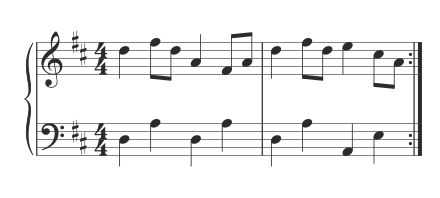
Figure 1:The running example as a score, engraved from the ABC file below.
The same piece in ABC notation, where L:1/8 makes a plain letter an eighth
note and d2 a quarter note:
X:1
T:Reel in D (running example)
M:4/4
L:1/8
Q:1/4=120
K:D
V:1
|: d2fd A2FA | d2fd e2cA :|
V:2 clef=bass
|: D,2A,2 D,2A,2 | D,2A,2 A,,2E,2 :|
The files are in the book’s repository: reel.abc, reel.krn, reel.musicxml, and reel_score.png. Three questions, one per level, come back throughout the chapter:
Perception: Which notes does the upper line play in bar 1? D5, F♯5, D5, A4, F♯4, A4.
Understanding: What key is it in? D major.
Reasoning: Why does the repeat sound like a return? Bar 2 ends on E5, C♯5, and A4 over A2 and E3, an A major chord. A major is the dominant of D, so the phrase ends open, and the repeat resolves it back to D.
A model that reads the ABC sees every note spelled out, so question 1 is a lookup and question 3 is the hard one. A model that hears the audio must first find the notes, so question 1 can be the hard one. One key thread, if you learn anything from this chapter, is that where the work falls depends on the representation, and that idea runs throughout as we will see.
Roadmap
How music gets into an LLM details the broad shared recipe of Music LLMs (encode, adapt, place in the sequence, train on the next token) and then each route in turn: audio, images of scores and spectrograms, and text and code. The pages include short code snippets that load open models from Hugging Face and ask them about the reel.
Perception and reasoning splits a musical question into hearing and thinking, reviews what is known about reasoning in audio LLMs, and shows how replacing the music with noise reveals what a model actually uses.
Evaluating music understanding surveys music benchmarks, shows how many questions can be answered without the music, and lists checks for building a benchmark.
Looking ahead asks why benchmarks age so fast and what the next ones should measure.
- Doh, S., Manco, I., Novack, Z., Kim, J. W., & Chen, K. (2024). Connecting Music Audio and Natural Language. Tutorial at the International Society for Music Information Retrieval Conference (ISMIR). https://mulab-mir.github.io/music-language-tutorial/
- Huang, Q., Jansen, A., Lee, J., Ganti, R., Li, J. Y., & Ellis, D. P. (2022). Mulan: A joint embedding of music audio and natural language. arXiv Preprint arXiv:2208.12415.
- Wu, Y., Chen, K., Zhang, T., Hui, Y., Berg-Kirkpatrick, T., & Dubnov, S. (2023). Large-scale contrastive language-audio pretraining with feature fusion and keyword-to-caption augmentation. IEEE International Conference on Audio, Speech and Signal Processing (ICASSP).
- Manco, I., Benetos, E., Quinton, E., & Fazekas, G. (2021). Muscaps: Generating captions for music audio. 2021 International Joint Conference on Neural Networks (IJCNN), 1–8.
- Doh, S., Choi, K., Lee, J., & Nam, J. (2023). Lp-musiccaps: Llm-based pseudo music captioning. International Society for Music Information Retrieval (ISMIR).
- Liu, S., Hussain, A. S., Sun, C., & Shan, Y. (2024). Music Understanding LLaMA: Advancing Text-to-Music Generation with Question Answering and Captioning. ICASSP 2024 - 2024 IEEE International Conference on Acoustics, Speech and Signal Processing (ICASSP), 286–290. 10.1109/ICASSP48485.2024.10447027
- Gardner, J. P., Durand, S., Stoller, D., & Bittner, R. M. (2024). LLark: A Multimodal Instruction-Following Language Model for Music. Proceedings of the 41st International Conference on Machine Learning, 235, 15037–15082. https://proceedings.mlr.press/v235/gardner24a.html
- Deng, Z., Ma, Y., Liu, Y., Guo, R., Zhang, G., Chen, W., Huang, W., & Benetos, E. (2024). MusiLingo: Bridging Music and Text with Pre-trained Language Models for Music Captioning and Query Response. In K. Duh, H. Gomez, & S. Bethard (Eds.), Findings of the Association for Computational Linguistics: NAACL 2024 (pp. 3643–3655). Association for Computational Linguistics. https://aclanthology.org/2024.findings-naacl.231
- Tang, C., Yu, W., Sun, G., Chen, X., Tan, T., Li, W., Lu, L., Ma, Z., & Zhang, C. (2024). SALMONN: Towards Generic Hearing Abilities for Large Language Models. The Twelfth International Conference on Learning Representations. https://openreview.net/forum?id=14rn7HpKVk
- Chu, Y., Xu, J., Zhou, X., Yang, Q., Zhang, S., Yan, Z., Zhou, C., & Zhou, J. (2023). Qwen-Audio: Advancing Universal Audio Understanding via Unified Large-Scale Audio-Language Models. arXiv. 10.48550/arXiv.2311.07919
- Xu, J., Guo, Z., He, J., Hu, H., He, T., Bai, S., Chen, K., Wang, J., Fan, Y., Dang, K., Zhang, B., Wang, X., Chu, Y., & Lin, J. (2025). Qwen2.5-Omni Technical Report. arXiv Preprint arXiv:2503.20215.
- Xu, J., Guo, Z., Hu, H., Chu, Y., Wang, X., He, J., Wang, Y., Shi, X., He, T., Zhu, X., Lv, Y., Wang, Y., Guo, D., Wang, H., Ma, L., Zhang, P., Zhang, X., Hao, H., Guo, Z., … Lin, J. (2025). Qwen3-Omni Technical Report. arXiv Preprint arXiv:2509.17765. https://arxiv.org/abs/2509.17765
- Ghosh, S., Goel, A., Kim, J., Kumar, S., Kong, Z., Lee, S., Yang, C.-H. H., Duraiswami, R., Manocha, D., Valle, R., & Catanzaro, B. (2025). Audio Flamingo 3: Advancing Audio Intelligence with Fully Open Large Audio Language Models. Advances in Neural Information Processing Systems. https://papers.neurips.cc/paper_files/paper/2025/hash/3babb6b453cb59d87cb58a1219ef914b-Abstract-Conference.html
- Ghosh, S., Goel, A., Koroshinadze, L., Lee, S., Kong, Z., Santos, J. F., Duraiswami, R., Manocha, D., Ping, W., Shoeybi, M., & others. (2026). Music Flamingo: Scaling Music Understanding in Audio Language Models. International Conference on Learning Representations (ICLR). https://arxiv.org/abs/2511.10289
- Gemma Team. (2026). Gemma 4 Technical Report. arXiv Preprint arXiv:2607.02770. https://arxiv.org/abs/2607.02770