When an audio LLM gets a music question wrong, there are two places it can fail. It may not hear what is there, or it may hear it and then draw the wrong conclusion. The key point of this page is to disentangle these two failure modes, which break down into two key concepts:
Perception the ability to extract what is in the input: the notes, onsets, chords, instruments, or symbols.
Reasoning the ability to combines those perceptions with knowledge to reach an answer. It can happen inside one forward pass, or explicitly, in written steps before the answer (reasoning models), in tool calls, or both.
A worked example
We start by asking “What is the melody here?” about the reel (Figure 1). The perception step may write down what sounds on each beat: two lines, an upper one in quarter and eighth notes around D5 and a lower one that alternates D3 and A3. The reasoning step decides which line is the melody. The upper line is higher and busier, and the lower line repeats one pattern, so it presumes the melody is the upper line (correctly!).
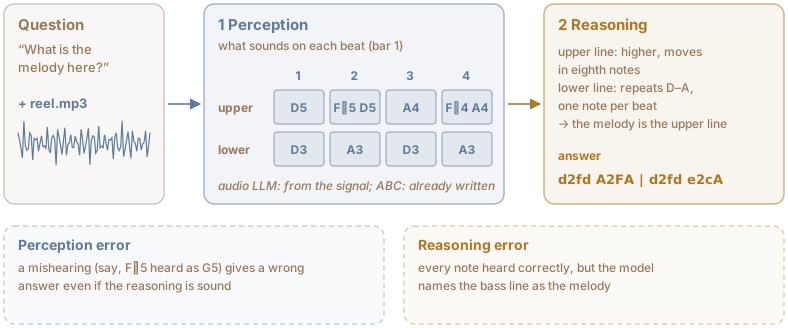
The two errors look the same in a benchmark score. They call for different fixes: a perception error may need a better encoder, more training on the signal, or a tool that transcribes; a reasoning error needs better knowledge or a better procedure. A model that thinks longer cannot fix notes it never heard (other than guessing).
How representation impacts perception vs. reasoning
The same question puts the work in different places depending on what the model sees. With ABC, the perception step for a question about melody is a lookup, because every pitch is spelled out. With audio, the perception step is a full transcription problem, even before getting to identify which notes are the melodic ones!
This notion has begun to be tested directly, such as in Carone et al. (2025). They give Gemini 2.5 Pro, Gemini 2.5 Flash, and Qwen2.5-Omni-7B three core perception tasks (syncopation scoring, transposition detection, and chord quality identification) once as MIDI and once as audio. The models “perform near ceiling on MIDI but show accuracy drops on audio”. Chain-of-thought and a logic-solver method (LogicLM) helped little: “neither CoT nor LogicLM compensated for upstream hearing errors”. The same pattern holds for score images: on MSU-Bench, the best model given the score as ABC text scores twice as high as the best model given it as an image (What the score benchmarks show).
Other benchmarks point the same way.
MUSE tests ten perception skills, such as pitch shift detection, rhythm matching, chord identification, and meter identification 2. Qwen2.5-Omni and Audio Flamingo 3 “perform at or near chance”, and chain-of-thought gives “inconsistent, often detrimental results”.
BASS asks 2,658 questions across 12 tasks on musical structure and semantics and evaluates 14 models 3. It finds that “current models leverage linguistic priors effectively but remain limited in reasoning over musical structure”.
HumMusQA, 320 hand-written questions curated and validated by experts with musical training, finds models “stronger at cultural and contextual reasoning than at formal analytical tasks” 4.
Cultural and contextual questions can be answered from what the model has read; formal analysis needs the notes. The pattern is what one would expect if perception, not reasoning, is the main bottleneck.
What helps reasoning in audio LLMs
Text LLMs became much better at math and code when they learned to use long reasoning chains before answering (Chapter 1). Audio LLMs did not follow this behavior at first. The Step-Audio-R1 report puts it bluntly: audio language models “consistently perform better with minimal or no reasoning” 5. Its fix, Modality-Grounded Reasoning Distillation, trains the model in rounds so that its reasoning shifts “from textual abstractions to acoustic properties”. The report states that the resulting model surpasses Gemini 2.5 Pro on its audio benchmarks.
That is the common thread: reasoning helps when it stays grounded in the signal, in a tool, or in a written procedure, but simply spending more tokens and “thinking step by step” does not translate to commensurate gains. Below, we highlight some key features from research expanding the capacity of reasoning about music:
Trained short reasoning. Audio Flamingo 3 trains on AF-Think, 250k multiple-choice questions with a “short, controlled thought” before the answer 6. Music Flamingo adds chain-of-thought examples grounded in music theory and then uses RL with GRPO 7.
Re-listening. Echo lets the model “re-listen” to parts of the audio during its reasoning 8. Supervised fine-tuning first teaches it to locate the salient segments, and reinforcement learning then rewards useful re-listening.
Thinking in audio features. CoAT gives the model “a continuous latent workspace for organizing acoustic information prior to response generation”, computed in a single prefill, and trains it with distillation from expert models 9.
Tools. AuTAgent trains, with reinforcement learning, a policy that “learns when and which tools to invoke”, calling external tools only when they improve on the base model 10. For symbolic music, CSyMR’s music21 agent and SymSkill’s written procedures play the same role (Music as procedures).
Verifiable rewards. When answers can be exactly or even approximately verified, they can be rewards. SSMR-Bench generates sheet-music questions from music-theory rules written as programs 11. Reinforcement learning on them raises Qwen3-8B-Base from 23.18 to 70.94 on SSMR-Bench’s text questions, and on the human-written MusicTheoryBench from 28.65 to 49.97 on average, with the reasoning subset going from 19.39 to 36.73.
Masking the music as detecting reasoning vs. perception
The simplest test of whether a model actually uses the music, and therefor is relying on any sort of perceptual ability, is to take it away. Specifically, one can keep the question fixed and change only the input, replacing the real audio with noise of the same length, silence, no audio at all, or a different clip. If accuracy barely moves, the model was not listening. The code below runs this check with the Qwen2-Audio model and processor from the audio page:
import numpy as np, librosa

def ask(question, audio=None):
    content = [{"type": "text", "text": question}]
    if audio is not None:
        content.insert(0, {"type": "audio", "audio": audio})
    inputs = processor.apply_chat_template(
        [{"role": "user", "content": content}], add_generation_prompt=True,
        tokenize=True, return_dict=True, return_tensors="pt").to(model.device)
    output = model.generate(**inputs, max_new_tokens=64)
    return processor.batch_decode(
        output[:, inputs["input_ids"].shape[1]:], skip_special_tokens=True)[0]

reel, sr = librosa.load("reel.mp3", sr=16000)   # the processor expects 16 kHz
rng = np.random.default_rng(0)
conditions = {
    "real":    reel,
    "noise":   0.1 * rng.standard_normal(len(reel)).astype(np.float32),
    "silence": np.zeros_like(reel),
    "none":    None,
}
question = ("What key is this piece in?\n"
            "A. D major\nB. G major\nC. B minor\nD. A major\n"
            "Answer with the letter only.")
for name, audio in conditions.items():
    print(name, ask(question, audio))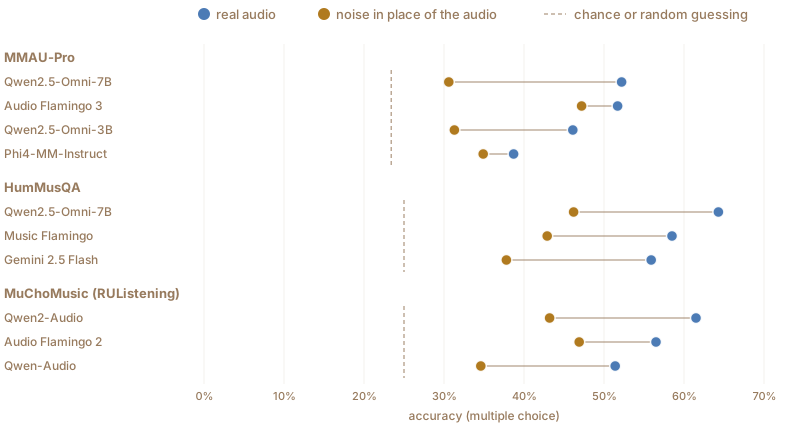
Figure 2:Accuracy with the real audio and with noise in its place, from MMAU-Pro 12, HumMusQA 4, and the RUListening study of MuChoMusic 13. The RUListening values are read from that paper’s figures.
The drop from real audio to noise shows the extent that the model relies on the audio (e.g. Qwen2.5-Omni-7B loses 21.6 points on MMAU-Pro). The level with noise shows how much the model answers from the question alone, and note that it is far above chance everywhere. Audio Flamingo 3 keeps 47.2% of its 51.7% on MMAU-Pro with noise in place of the audio. HumMusQA also tests silence and gets about the same numbers as with noise: 47.0% for Qwen2.5-Omni-7B, 42.2% for Music Flamingo, and 39.8% for Gemini 2.5 Flash.
Swapping in a different real clip is another valid control, because the input still sounds like music. Lin et al. (2026) run nine audio LLMs on six tasks, from instrument recognition to time signature. They find that text-similarity metrics on the models’ answers “do not materially change when the audio input to the LALM is replaced with a random different audio clip”, so they score labels with precision, recall, and F1 instead. Even then, for time signature, “predictions are no more accurate when given the actual audio than when given random audio”, and “a model that always guesses 4/4 scores 0.869, matching or exceeding every model”.
As we will see in the evaluation section, this analysis serves less of a strong critique over a given models reasoning abilities, and moreso a meta-evaluation on the quality of a benchmark itself.
- Carone, B. J., Roman, I. R., & Ripollés, P. (2025). Evaluating Multimodal Large Language Models on Core Music Perception Tasks. arXiv Preprint arXiv:2510.22455. https://arxiv.org/abs/2510.22455
- Carone, B. J., Roman, I. R., & Ripollés, P. (2025). The MUSE Benchmark: Probing Music Perception and Auditory Relational Reasoning in Audio LLMs. arXiv Preprint arXiv:2510.19055. https://arxiv.org/abs/2510.19055
- Jang, M., Ahia, O., Tamer, N., Kumar, S., Tsvetkov, Y., & Smith, N. A. (2026). BASS: Benchmarking Audio LMs for Musical Structure and Semantic Reasoning. arXiv Preprint arXiv:2602.04085. https://arxiv.org/abs/2602.04085
- Weck, B., Puentes, P., Poltronieri, A., Prabhu, S., & Bogdanov, D. (2026). HumMusQA: A Human-written Music Understanding QA Benchmark Dataset. arXiv Preprint arXiv:2603.27877. 10.18653/v1/2026.nlp4musa-1.9
- Tian, F., Zhang, X. T., Zhang, Y., Zhang, H., Li, Y., Liu, D., Deng, Y., Wu, D., Chen, J., Zhao, L., Yao, C., Liu, H., Chng, E. S., Yang, X., Zhang, X., Jiang, D., & Yu, G. (2025). Step-Audio-R1 Technical Report. arXiv Preprint arXiv:2511.15848. https://arxiv.org/abs/2511.15848
- Ghosh, S., Goel, A., Kim, J., Kumar, S., Kong, Z., Lee, S., Yang, C.-H. H., Duraiswami, R., Manocha, D., Valle, R., & Catanzaro, B. (2025). Audio Flamingo 3: Advancing Audio Intelligence with Fully Open Large Audio Language Models. Advances in Neural Information Processing Systems. https://papers.neurips.cc/paper_files/paper/2025/hash/3babb6b453cb59d87cb58a1219ef914b-Abstract-Conference.html
- Ghosh, S., Goel, A., Koroshinadze, L., Lee, S., Kong, Z., Santos, J. F., Duraiswami, R., Manocha, D., Ping, W., Shoeybi, M., & others. (2026). Music Flamingo: Scaling Music Understanding in Audio Language Models. International Conference on Learning Representations (ICLR). https://arxiv.org/abs/2511.10289
- Wu, D., Zhang, X., Yang, D., Yao, J., Chen, L., Liu, Q., Zhao, S., Ma, C., Kang, Y., & Zhou, Y. (2026). Echo: Towards Advanced Audio Comprehension via Audio-Interleaved Reasoning. International Conference on Learning Representations (ICLR). https://arxiv.org/abs/2602.11909
- Han, G., Lee, D.-J., Choi, C., Kim, J., & Kim, J. (2026). Continuous Audio Thinking for Large Audio Language Models. arXiv Preprint arXiv:2606.18273. https://arxiv.org/abs/2606.18273
- Tong, S., Li, X., Wang, Y., Bi, B., Cai, Y., Liu, S., He, Y., & Hao, C. (2026). AuTAgent: A Reinforcement Learning Framework for Tool-Augmented Audio Reasoning. arXiv Preprint arXiv:2602.13685. https://arxiv.org/abs/2602.13685
- Wang, Z., Yang, Z., Luo, Y., Li, Y., Qu, X., Qiao, Z., Zhang, H., Zhan, R., Wong, D. F., Zhou, J., & Cheng, Y. (2025). Towards an AI Musician: Synthesizing Sheet Music Problems for Musical Reasoning. arXiv Preprint arXiv:2509.04059.
- Kumar, S., Sedláček, Š., Lokegaonkar, V., López, F., Yu, W., Anand, N., & others. (2025). MMAU-Pro: A Challenging and Comprehensive Benchmark for Holistic Evaluation of Audio General Intelligence. arXiv Preprint arXiv:2508.13992.
- Zang, Y., O’Brien, S., Berg-Kirkpatrick, T., McAuley, J., & Novack, Z. (2025). Are You Really Listening? Boosting Perceptual Awareness in Music-QA Benchmarks. arXiv Preprint arXiv:2504.00369.
- Lin, D. C., Freeman, M., & Thickstun, J. (2026). Assessing Factual Music Comprehension in Large Audio Language Models. Proceedings of the 27th International Society for Music Information Retrieval Conference (ISMIR). https://arxiv.org/abs/2511.05550