To evaluate an LLM, we run it on prompts it has not seen and score its answers. Two things make the scoring harder than for a classifier. The answer is free text, so a program has to find the answer in it, or someone has to judge it. And the model picks each token by sampling, so the same prompt can get a different answer on the next run. Chapter 2 covers music benchmarks and listening checks for audio LLMs, such as rerunning a test with noise in place of the audio to see whether the score drops.
Answers a program can check
Some questions have one right answer, such as the number of sharps in E major or the relative minor of C major. Others have a reference answer, such as the key an annotator gave a track. The model may wrap that answer in a sentence, so the prompt asks for a fixed format, such as a key name or a list of beat times, and a program extracts the answer. Answers that cannot be extracted, such as “A minor, or maybe E minor”, usually count as wrong, and reading a sample of the raw answers shows whether the extraction works.
MIR’s usual metrics then apply, with their musical tolerances. In one common tempo score, an estimate within 4% of the annotation counts as correct, and a second score also accepts other metrical levels, such as half or double the tempo 1. Listeners themselves often tap at those levels 2. In mir_eval’s key score, the key a fifth above, the relative key, and the parallel key earn partial credit 3.
A tolerance can also hide errors that matter in use. A 126 BPM track estimated at 124 counts as correct. A DJ tool that trusts the estimate would mix it unadjusted with a 124 BPM track. Their kicks would drift apart by about 30 ms per bar and land on each other’s off-beats after eight bars.
For multiple-choice questions, guessing sets the baseline: with four options, chance is 25%. The scoring rule, the points that each kind of answer earns, sets the value of a guess. If a wrong answer and “I don’t know” both score zero, guessing never scores lower than admitting uncertainty. Kalai et al. (2025) argue that models hallucinate because training and evaluation reward guessing in this way. They propose stating the scores in the prompt and scoring a wrong answer below “I don’t know”, for example +1 for a right answer, 0 for “I don’t know”, and −1 for a wrong one. Blind guessing among four options then averages −0.5 points.
Answers that need a judge
The three descriptions of the funk track from the RL section have no single correct wording. Table 1 scores them in two ways. The first counts the five annotated facts (funk, E minor, 104 BPM, 4/4, horns) that each description matches. The second uses two word-overlap metrics, which compare each description with a reference caption written for this example: “An upbeat funk track in E minor, led by a tight horn section over a steady 4/4 groove at 104 BPM.”
Table 1:Scores for the three RL descriptions. BLEU-4 scores the share of one- to four-word sequences in a description that also appear in the reference caption. It lowers the score of descriptions shorter than the reference. ROUGE-1 F1 is the F-measure of shared words.
| Description | Facts matched | BLEU‑4 | ROUGE-1 F1 |
|---|---|---|---|
| A: “Tight funk groove in E minor, 104 BPM in 4/4, with horns.” | 5 of 5 | 0.12 | 0.55 |
| B: “A funk track around 104 BPM with a synth bass line.” | 2 of 5 | 0.08 | 0.38 |
| C: “A laid-back jazz ballad in E major, led by piano.” | 0 of 5 | 0.08 | 0.31 |
BLEU-4 gives B (two facts right) and C (none) the same score to two decimals, and ROUGE-1 ranks C only slightly lower, because C shares “in E” and “led by” with the reference. Fact matching separates the three, but it scores C’s wrong key the same as B’s missing key; a separate count of wrong claims tells them apart. It also cannot check claims outside the annotations, such as B’s synth bass line.
People who hear the track catch some errors, such as piano in place of horns. Other errors need training: hearing that description C’s “E major” is wrong takes a trained ear, and a claim about voice leading needs a theorist. A rater who can neither hear the track nor see its annotations can judge little more than fluency. Experts also disagree with each other. Flexer & Grill (2016) argue that their agreement among themselves limits what a system’s agreement with them can show: near that level, small differences between systems say little.
An LLM can also be the judge. It can grade one answer against a rubric, a list of criteria to check, or pick the better of two answers. On general chat questions, the strongest LLM judge agreed with expert raters about as often as the experts agreed with each other, but judges also preferred longer answers and often changed their verdict when the two answers swapped places 6. Judging each pair in both orders counters the second effect.
A text-only judge cannot hear the track and must be given the facts. It can then match wordings a program would miss, such as “brass section” for horns. On music, Chapter 2 reports a study in which an LLM judge was unreliable at finding errors in MIR annotations, such as beat and chord labels.
Agents
An agent is scored by the result of its whole run. For the DJ warm-up set, rerunning the agent’s own tempo estimator to check the tempi would repeat its errors. The check runs on many test folders, with tempi annotated for each. It confirms that each track is in the folder and appears once, that the tempi rise from 120 to 126 BPM, and that the durations, minus the overlap at each transition, sum to about 20 minutes. If the request also asked for keys that mix well, a program can check each key change against annotated keys. A warm-up set is also expected to rise in energy. A DJ can judge this, or an audio LLM judge first checked against a DJ’s ratings on some sets.
A model or an agent can be given attempts at a task. pass@k counts the task as solved if any attempt succeeds 7. It suits a DJ who listens to each proposed set and keeps a good one. pass^k counts it as solved only if all attempts succeed 8. It suits an agent that builds a set every night with nobody checking, where every set must work. Figure 1 compares the two for an agent that builds an acceptable set on 60% of its attempts.
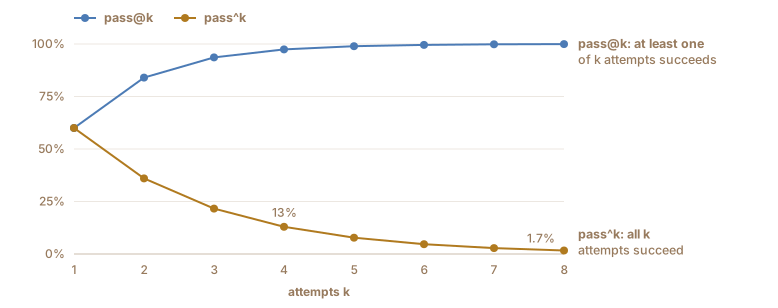
Figure 1:pass@k and pass^k for an agent that succeeds on 60% of its attempts at one task, assuming the attempts are independent. Over several tasks, both are computed task by task and then averaged. Tasks the agent never solves keep pass@k from rising this fast, and tasks it always solves keep pass^k from falling this fast.
Pitfalls
A model may have read a benchmark’s questions and answers on the web during pre-training, which is called contamination 910. The keys and tempi of well-known songs are listed online too, so a model may give the key or tempo of a famous track without listening.
Scores depend on the prompt and other settings. One technical report gave its model 90.0% on a multiple-choice knowledge test with 32 sampled chains of thought per question, and 83.7% with a prompt of five solved examples, the setup behind a rival model’s reported 86.4% 11. A comparison holds only when every model is run with the same setup.
A score is an estimate. With questions, the share answered correctly has a 95% confidence interval of at most about ±10 points for 100 questions and ±5 for 400. One large lab’s model report lists this interval with every benchmark score 10. On a music-theory test of 98 four-option questions, the test’s authors reported about 26% for a leading model of the time 12. The interval around that score, from 17% to 35%, includes the 25% expected from guessing.
Testing a model on your own task
A test for an MIR task starts from examples with answers you trust, such as annotated keys or tempi. Tracks that are not well known, file names and tags that do not give the answer, and examples kept offline guard against contamination. The model can hear the tracks itself, as an audio LLM does (Chapter 2), or call MIR tools, as the DJ agent does. By the interval above, a few dozen examples can show that a model falls far short, but telling apart two models a few points apart takes hundreds to thousands of questions. Running each question several times and averaging the scores gives a steadier estimate, as large labs do for reasoning models 13. The result is then compared with the system you use today, such as a beat tracker or a tagger.
Large labs’ model reports state the setup behind each score, such as the prompt format, the temperature, and the number of runs per question 1013. For an MIR test, the setup also includes the number of tracks, the source of the reference answers, the count of answers that could not be extracted or said “I don’t know”, and, for an agent, its harness and tools. A model you reach through a company’s service can change while its name stays the same, so the date of the run matters too 14.
Tests written by music experts
Music tests for LLMs often take their reference answers from metadata, from the output of MIR tools, or from multiple-choice questions their authors wrote. A reference answer taken from a tool carries the tool’s errors, such as the half-tempo error in the DJ example, and such tests ask what is easy to score: a tag, a key, one of four options. Musicians also judge music in other terms, such as whether a voicing suits the style or whether a groove sits behind the beat.
In other fields, experts write the tests. In a graduate-level science test, domain experts wrote each question and other experts checked it. Experts answered 65% correctly in their own field, and skilled non-experts with web access 34% 15. For a widely used coding benchmark, professional developers screened the tasks, and the 500 they judged well specified and fairly tested replaced the original set 16. In music, Chapter 5 describes a test in which 18 professional vocal trainers annotated 515 recordings, and audio LLMs rarely matched their diagnoses 17.
Musicians, theorists, and teachers can write such tests in their own terms, and MIR researchers bring two decades of shared evaluation through MIREX 18. The methods on this page apply: answers that several experts agree on, or a measured level of disagreement among them; recordings that are not well known; and part of the test kept private. Questions that no current model answers correctly are worth keeping, because they show developers what to fix.
- Gouyon, F., Klapuri, A., Dixon, S., Alonso, M., Tzanetakis, G., Uhle, C., & Cano, P. (2006). An Experimental Comparison of Audio Tempo Induction Algorithms. IEEE Transactions on Audio, Speech, and Language Processing, 14(5), 1832–1844.
- McKinney, M. F., & Moelants, D. (2006). Ambiguity in Tempo Perception: What Draws Listeners to Different Metrical Levels? Music Perception, 24(2), 155–166.
- Raffel, C., McFee, B., Humphrey, E. J., Salamon, J., Nieto, O., Liang, D., & Ellis, D. P. (2014). mir_eval: A Transparent Implementation of Common MIR Metrics. International Society for Music Information Retrieval (ISMIR).
- Kalai, A. T., Nachum, O., Vempala, S. S., & Zhang, E. (2025). Why Language Models Hallucinate. arXiv Preprint arXiv:2509.04664. https://arxiv.org/abs/2509.04664
- Flexer, A., & Grill, T. (2016). The Problem of Limited Inter-rater Agreement in Modelling Music Similarity. Journal of New Music Research, 45(3), 239–251. 10.1080/09298215.2016.1200631
- Zheng, L., Chiang, W.-L., Sheng, Y., Zhuang, S., Wu, Z., Zhuang, Y., Lin, Z., Li, Z., Li, D., Xing, E. P., & others. (2023). Judging LLM-as-a-Judge with MT-Bench and Chatbot Arena. Advances in Neural Information Processing Systems, Datasets and Benchmarks Track. https://arxiv.org/abs/2306.05685
- Chen, M., Tworek, J., Jun, H., Yuan, Q., Pinto, H. P. de O., Kaplan, J., Edwards, H., Burda, Y., Joseph, N., Brockman, G., & others. (2021). Evaluating Large Language Models Trained on Code. arXiv Preprint arXiv:2107.03374. https://arxiv.org/abs/2107.03374
- Yao, S., Shinn, N., Razavi, P., & Narasimhan, K. (2025). τ-bench: A Benchmark for Tool-Agent-User Interaction in Real-World Domains. International Conference on Learning Representations (ICLR). https://arxiv.org/abs/2406.12045
- Brown, T., Mann, B., Ryder, N., Subbiah, M., Kaplan, J., Dhariwal, P., Neelakantan, A., Shyam, P., Sastry, G., Askell, A., & others. (2020). Language Models are Few-Shot Learners. Advances in Neural Information Processing Systems, 33, 1877–1901. https://arxiv.org/abs/2005.14165
- Grattafiori, A., Dubey, A., Jauhri, A., Pandey, A., Kadian, A., Al-Dahle, A., Letman, A., Mathur, A., Schelten, A., Vaughan, A., Yang, A., Fan, A., & others. (2024). The Llama 3 Herd of Models. arXiv Preprint arXiv:2407.21783. https://arxiv.org/abs/2407.21783
- Gemini Team. (2023). Gemini: A Family of Highly Capable Multimodal Models. arXiv Preprint arXiv:2312.11805.
- Yuan, R., Lin, H., Wang, Y., Tian, Z., Wu, S., Shen, T., Zhang, G., Wu, Y., Liu, C., Zhou, Z., & others. (2024). ChatMusician: Understanding and Generating Music Intrinsically with LLM. Findings of the Association for Computational Linguistics: ACL 2024, 6252–6271.
- Guo, D., & others. (2025). DeepSeek-R1 Incentivizes Reasoning in LLMs through Reinforcement Learning. Nature, 645(8081), 633–638. 10.1038/s41586-025-09422-z
- Chen, L., Zaharia, M., & Zou, J. (2024). How Is ChatGPT’s Behavior Changing over Time? Harvard Data Science Review, 6(2). 10.1162/99608f92.5317da47
- Rein, D., Hou, B. L., Stickland, A. C., Petty, J., Pang, R. Y., Dirani, J., Michael, J., & Bowman, S. R. (2024). GPQA: A Graduate-Level Google-Proof Q&A Benchmark. Conference on Language Modeling (COLM). https://arxiv.org/abs/2311.12022