When music is written as text, there is no interface needed: the tokenizer is the interface. Every LLM can read ABC or MusicXML today, and Chapter 1 shows how a bar of ABC splits into tokens. This page compares notation formats, shows how to prompt a text LLM with one, and then turns to code: libraries the LLM can call, programs it can write, and written procedures it can follow.
Notation formats
Three formats cover most of the work on LLMs and textual representations of symbolic music. Here is the reel in each, with the size of each file.
ABC is “a system designed to notate music in plain text format”, and the
de facto standard for folk and traditional music (abcnotation.com). The reel’s
full file, shown on the overview, is 143 characters. Letters
are pitches, case and commas or apostrophes set the octave, numbers multiply the
default length, and V: starts a voice.
**kern is a Humdrum representation for “basic or core information for period-of-common-practice Western music” (humdrum.org). Each column, or spine, is a voice, and each row is a moment in time, so simultaneous notes sit on the same line. The reel in **kern is 195 characters:
**kern	**kern
*staff2	*staff1
*clefF4	*clefG2
*k[f#c#]	*k[f#c#]
*M4/4	*M4/4
=1-	=1-
4D	4dd
4A	8ff#L
.	8ddJ
4D	4a
4A	8f#L
.	8aJ
=2	=2
4D	4dd
4A	8ff#L
.	8ddJ
4AA	4ee
4E	8cc#L
.	8aJ
=:|!	=:|!
*-	*-
A 4 is a quarter note and an 8 an eighth; repeated letters move by octave
(dd is D5, AA is A2); L and J open and close a beam; and a . means the
voice is still sounding.
MusicXML is the format notation software exports (MuseScore, Sibelius, etc.). It spells out every attribute in XML. The reel’s file, exported by music21, is 7,335 characters, 51 times the ABC, and its first note alone takes eight lines:
<note>
  <pitch>
    <step>D</step>
    <octave>5</octave>
  </pitch>
  <duration>10080</duration>
  <type>quarter</type>
</note>
The files carry the same notes, but not the same information. ABC and **kern here say nothing about dynamics or instruments, and MusicXML has room for layout, lyrics, and articulations. Other formats include MEI, LilyPond, and MIDI events written as tokens. Longer files cost more tokens and context, and a format the LLM rarely saw in training may be harder for it to read. Note that while bespoke symbolic tokenization schemes are generally the provenance of dedicated research on symbolic music generation or simple understanding tasks, most research on LLMs parsing music as text forgo these and instead rely on the strong natural language prior of the model itself.
General LLMs and music LLMs
A general LLM reads notation it met during pre-training. Music LLMs train further on notation:
ChatMusician continues training LLaMA2-7B on MusicPile, a 4B-token corpus that includes music scores in ABC 1. Its benchmark, MusicTheoryBench, has 372 four-option questions, 269 on music knowledge and 98 on music reasoning. At release, GPT-4 scored 25.6 on the reasoning questions, about chance, and 36.7 with chain-of-thought prompting.
NotaGen pre-trains a 516M-parameter model on 1.6M pieces in an interleaved ABC, where “different voices of the same bar are rearranged into a single line”, then fine-tunes it and refines it with preference optimization, using CLaMP 2 as the judge 2.
MIDI-LLM expands Llama 3.2 1B’s vocabulary with MIDI tokens and trains it for text-to-MIDI generation 3.
The last two are generation models; Chapter 4 covers generation. For understanding, the main question is whether a general LLM can read the notation well enough, and the perception and reasoning page shows that it usually reads it far better than it hears audio.
Asking a text LLM about the reel
Any chat LLM can take the ABC in its prompt. The code below follows the model card of Qwen2.5-7B-Instruct 4, the text-only sibling of the models on the previous pages:
# pip install transformers accelerate
from transformers import AutoModelForCausalLM, AutoTokenizer

model_name = "Qwen/Qwen2.5-7B-Instruct"
model = AutoModelForCausalLM.from_pretrained(model_name, torch_dtype="auto", device_map="auto")
tokenizer = AutoTokenizer.from_pretrained(model_name)

abc = open("reel.abc").read()
messages = [{"role": "user", "content":
             f"Here is a tune in ABC notation:\n\n{abc}\n\n"
             "What key is it in? Which chord ends bar 2, and why does the "
             "repeat sound like a return?"}]

text = tokenizer.apply_chat_template(messages, tokenize=False, add_generation_prompt=True)
model_inputs = tokenizer([text], return_tensors="pt").to(model.device)
generated_ids = model.generate(**model_inputs, max_new_tokens=512)
generated_ids = [out[len(inp):] for inp, out in zip(model_inputs.input_ids, generated_ids)]
print(tokenizer.batch_decode(generated_ids, skip_special_tokens=True)[0])
Here the perception question is almost free: every pitch is spelled out, and
K:D names the key. The reasoning question is still open. The model has to
find the A major chord at the end of bar 2 by combining the melody’s E, C♯, and
A with the bass’s A and E, which sit in different lines of the file.
Music as code
Text can also be a program. If you haven’t been living under a rock the past year, modern frontier LLMs write code quite well (Chapter 1), and this can be extended to music as well.
Analysis libraries.
Chiefly, modern LLMs can interact with music by simply using the wealth of open-source
libraries for performing music understanding, and using its API as an interface with the music itself.
music21, for example, is a Python toolkit for computer-aided
musicology 5. It parses ABC, **kern, MusicXML, and MIDI
into one score object.
An LLM that may call music21’s analyze("key") function (which runs the Krumhansl–Schmuckler
key-finding algorithm) does not need to find the key by directly looking at the music at all. It simply needs to know which function answers the question, and how to read the
result.
Live-coding languages. Modern LLMs can also interact with music creation through the space of live-coding languages, which are used for interactive music performances. Strudel writes music as patterns in JavaScript. The reel is two patterns played together:
stack(
  note("d5 [f#5 d5] a4 [f#4 a4] d5 [f#5 d5] e5 [c#5 a4]"),
  note("d3 a3 d3 a3 d3 a3 a2 e3")
).cpm(15)
Each pattern divides one cycle into eight steps, and brackets split a step in
two, so [f#5 d5] is two eighth notes. stack plays the patterns at the same
time, and .cpm(15) sets 15 cycles per minute: four seconds per cycle, two bars
at 120 BPM. A recent work, Decomposer, showed that LLMs can go the other way: it learns to turn MIDI into Strudel
programs 6. It is trained first on Strudel-Synth, a
synthetic corpus of programs and the MIDI they render, then with reinforcement
learning on unpaired MIDI, with rewards for both reconstruction faithfulness and
code readability.
Tools and MCPs. A tool call lets an LLM run a function and read its result, providing another layer of abstraction between the LLM agent and the underlying libraries that support the tool. The Model Context Protocol (MCP) is an open standard for connecting LLM applications to tools and data 7, so a tool written once works with any application that supports it. Third-party MCP servers exist for music software. One, for Ableton Live (ableton-mcp), lets an LLM create tracks and MIDI clips, load instruments, and change the tempo. Importantly, this means that with tools like these, a text-only LLM (such as Claude) can work with music it never hears.
Music as procedures
Tools give the capacity to extract information from music without directly perceiving it, but the model still has to plan around how to use them. Some recent work Two papers from 2026 study this idea of agentic programming for music in the context of symbolic music (Figure 1).
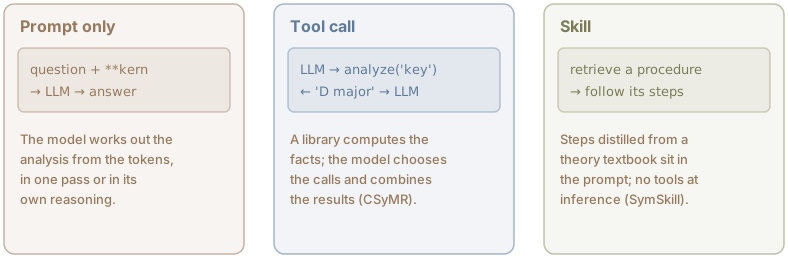
Figure 1:Prompt only, tool calls, and skills.
CSyMR is a benchmark of 126 multiple-choice questions on scores in **kern, drawn from r/musictheory discussions (2012–2022) and college-level music theory exams 8. Its agent runs a ReAct loop 9 with music21 operations as tools, which yields “5–7% absolute accuracy gains”. On the paper’s average, the music21 agent scores 66.67%, against 61.11% for ReAct without music tools, 61.90% for few-shot chain-of-thought, and 50.79% zero-shot.
SymSkill takes the tools away at inference 10. It distills analysis procedures from a music-theory textbook, Open Music Theory, into a graph of skills, written steps for tasks such as identifying a cadence. At test time, the relevant skills are retrieved into the prompt, and the model follows them with no tool calls. On CSyMR, the skills raise Qwen3.5-4B from 42.86% (its best result without skills) to 48.41%, and Qwen3.5-9B from 35.71% to 50.00%. The paper also evaluates on MusicTheoryBench and SSMR-Bench.
The idea matches agent skills in general LLM products: folders of instructions that an agent loads into its context when a task calls for them 11.
- Yuan, R., Lin, H., Wang, Y., Tian, Z., Wu, S., Shen, T., Zhang, G., Wu, Y., Liu, C., Zhou, Z., & others. (2024). ChatMusician: Understanding and Generating Music Intrinsically with LLM. Findings of the Association for Computational Linguistics: ACL 2024, 6252–6271.
- Wang, Y., Wu, S., Hu, J., Du, X., Peng, Y., Huang, Y., Fan, S., Li, X., Yu, F., & Sun, M. (2025). NotaGen: Advancing Musicality in Symbolic Music Generation with Large Language Model Training Paradigms. arXiv Preprint arXiv:2502.18008.
- Wu, S.-L., Carlton, D., Miyakawa, R., Kim, Y., Donahue, C., & Huang, C.-Z. A. (2025). MIDI-LLM: Improving Text-to-MIDI Music Generation via Adapting Large Language Models. arXiv Preprint arXiv:2511.03942. https://arxiv.org/abs/2511.03942
- Qwen Team. (2024). Qwen2.5 Technical Report. arXiv Preprint arXiv:2412.15115. https://arxiv.org/abs/2412.15115
- Cuthbert, M. S., & Ariza, C. (2010). music21: A Toolkit for Computer-Aided Musicology and Symbolic Music Data. Proceedings of the 11th International Society for Music Information Retrieval Conference (ISMIR).
- Kim, Y., Gandhi, A., Chung, D., Neubig, G., & Donahue, C. (2026). Decomposer: Learning to Decompile Symbolic Music to Programs. arXiv Preprint arXiv:2607.01849. https://arxiv.org/abs/2607.01849
- Anthropic. (2024). Introducing the Model Context Protocol. Anthropic news. https://www.anthropic.com/news/model-context-protocol
- Wang, B., Vishe, Y., Xu, X., Novack, Z., Jiang, X., McAuley, J., & Wu, J. (2026). CSyMR: Benchmarking Compositional Music Information Retrieval in Symbolic Music Reasoning. Proceedings of the 49th International ACM SIGIR Conference on Research and Development in Information Retrieval, 4244–4249. https://arxiv.org/abs/2601.11556
- Yao, S., Zhao, J., Yu, D., Du, N., Shafran, I., Narasimhan, K., & Cao, Y. (2023). ReAct: Synergizing Reasoning and Acting in Language Models. International Conference on Learning Representations (ICLR). https://arxiv.org/abs/2210.03629
- Wu, J., Wang, B., Jiang, X., Yadavalli, A., Wang, Z., Yan, Q., Wen, H., & McAuley, J. (2026). SymSkill: Skill Graph for Symbolic Music Understanding. Proceedings of the 27th International Society for Music Information Retrieval Conference (ISMIR).
- Anthropic. (2025). Agent Skills Specification. https://github.com/anthropics/skills